Most cutting board decisions get framed as a wood question, but the choice that actually shapes how a board performs is its construction. Edge grain, end grain, and molded plastic each cut, wear, and age differently, and each suits a different buyer. If you are ordering boards in bulk, personalizing them as gifts, or outfitting a working kitchen, understanding the three constructions will save you from paying for qualities you do not need or skimping on ones you do.
How the three constructions are built
Edge grain boards are made by laying long hardwood rails, usually maple, walnut, or cherry, side by side and gluing them together so the long fibers run horizontally across the surface. This is the most common wood board you will see, and it is the more affordable of the two wood constructions because it uses fewer glue joints and less labor. End grain boards flip the geometry: short square blocks of the same hardwoods are stood on end and glued into a checkerboard, so you cut into the tips of the wood fibers rather than across them. That extra cutting, arranging, and gluing is why end grain boards cost more to produce.
HDPE and other food-grade plastics are molded or cut from solid sheet into a uniform slab with no grain at all. They are the cheapest to produce, the lightest to handle, and the only one of the three that is reliably dishwasher-safe. Each construction answers a different priority, so the honest way to choose is to decide which single property matters most for your use and work backward from there.
Knife-friendliness and how each surface wears
End grain boards have a genuine mechanical advantage for knife edges. When a blade meets the standing fibers, it slides between them, the fibers separate, and then they close back up, which keeps the edge sharper for longer and hides cut marks. This self-healing behavior is the main reason serious cooks and knife owners pay the premium. Edge grain boards are still knife-friendly and easy to live with, but they show visible cut lines over time; the upside is that a wood edge grain board can be sanded flat and re-oiled to look new again.
Plastic behaves differently. It does not dull knives quickly, but it does not heal either. Repeated cutting leaves permanent knife grooves, and once those grooves are deep and numerous they become harder to clean thoroughly and can hold moisture and food residue. The practical answer with plastic is rotation and replacement: run boards until the surface is heavily scored, then retire them, which is manageable precisely because they are inexpensive.
Wood hardness and why the sweet spot matters
Among wood boards, the species sets the hardness, and hardness is a balancing act rather than a “harder is better” contest. A board that is too soft scars and gouges easily; a board that is too hard feels punishing under the knife and can accelerate edge dulling. That is why the classic board woods cluster in a middle band of the Janka hardness scale. Black cherry sits around 950 lbf and black walnut around 1,010 lbf, both gentle on edges; beech lands near 1,300 lbf; and hard maple, the workhorse of American cutting boards, comes in at about 1,450 lbf, firm enough to resist scarring while staying kind to blades.
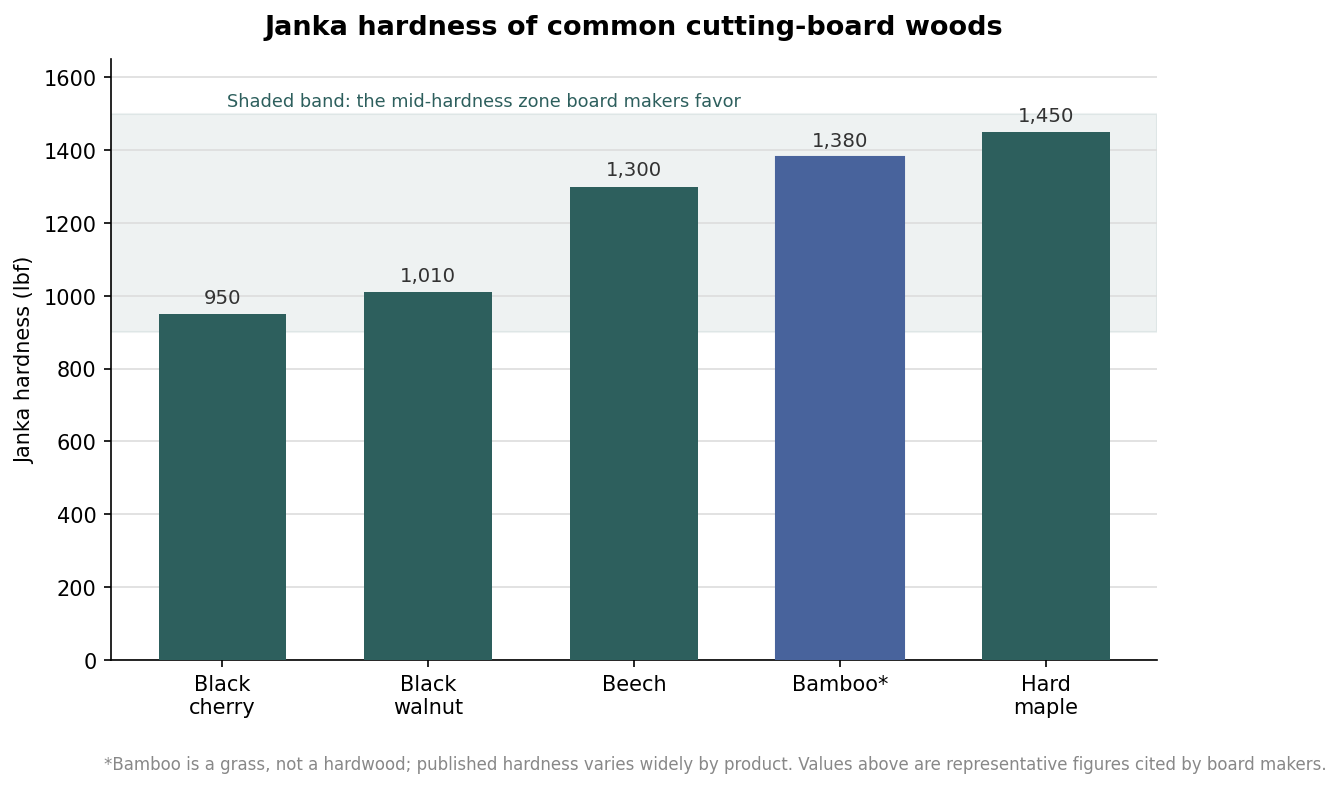
Bamboo often gets marketed as a premium eco option, and representative figures put it near 1,380 lbf, but bamboo is a grass rather than a hardwood, its published hardness varies widely by product, and the adhesives and fibrous structure make it noticeably tougher on knife edges than maple or walnut. If edge retention is a priority, treat bamboo with more skepticism than its marketing suggests. Exotic woods like teak are sometimes cited at much higher hardness numbers, but those figures are inconsistent across sources and species, so verify the specific product rather than trusting a single quoted value.
Thickness, weight, and upkeep
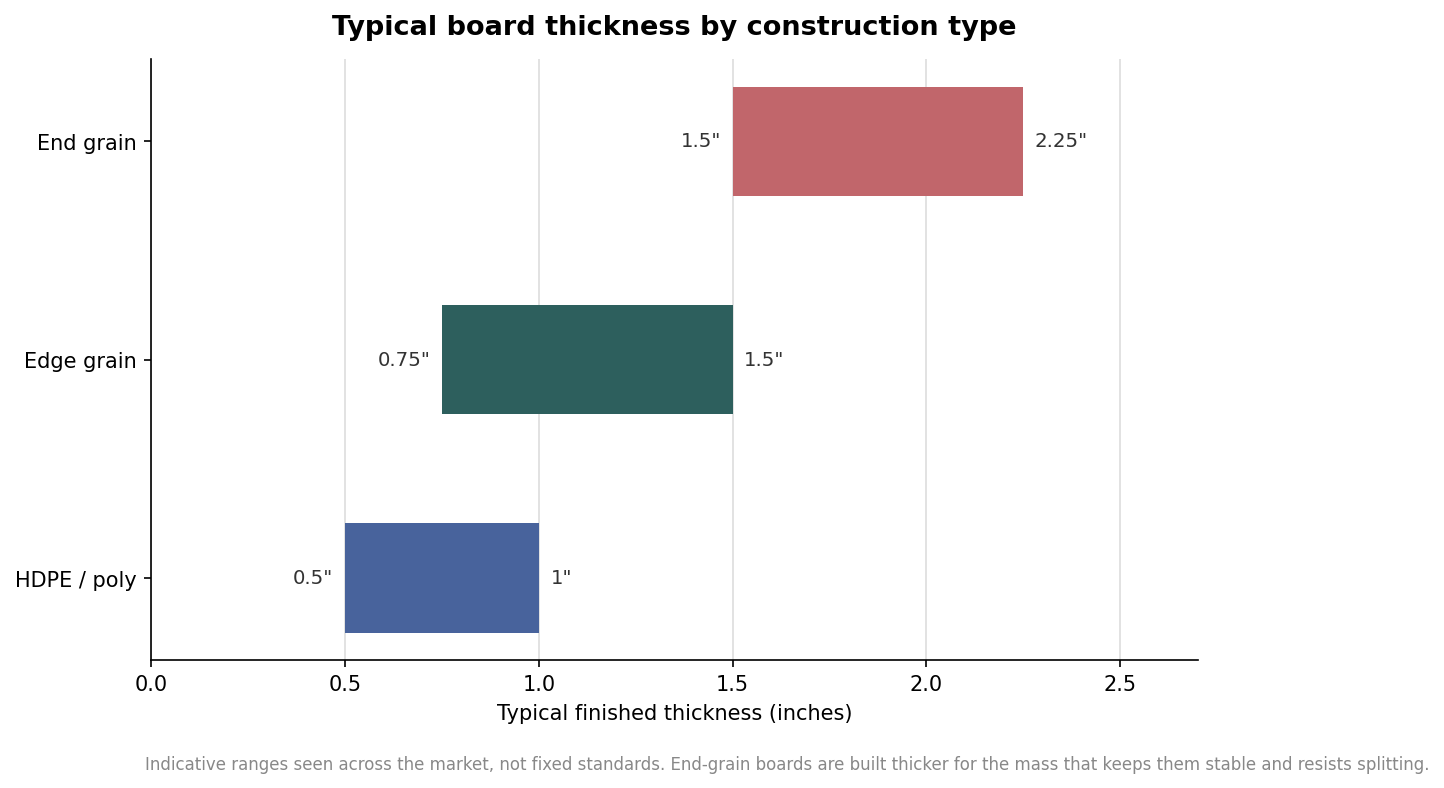
Construction also drives how thick and heavy a board needs to be. End grain boards are built thick, commonly in the range of one and a half to over two inches, because that mass keeps the checkerboard stable and resists the splitting that end-grain construction is prone to if it dries unevenly. Edge grain boards are typically three-quarters of an inch to about an inch and a half, and plastic boards are often around half an inch to an inch. Those are indicative market ranges rather than fixed standards, but the pattern holds: the more premium the wood construction, the more board you are lifting, storing, and washing by hand.
Upkeep tracks the same lines. Both wood constructions need regular food-safe mineral oil and occasional board cream to stay sealed, and end grain generally drinks up more oil because of all the exposed fiber ends. Neither wood board should go in a dishwasher or soak in water. Plastic asks for almost nothing beyond hot soapy water or a dishwasher cycle, which is exactly why it dominates in high-volume settings where boards are washed constantly and cross-contamination rules require frequent sanitizing.
Matching the construction to the buyer
For a personalized gift or a centerpiece board that will be shown as much as used, end grain is the natural pick: it looks the most impressive, protects good knives, and carries engraving beautifully on its dense end surface. For everyday home cooking or a bulk order where value and easy refinishing matter, edge grain hardwood is the sensible middle, delivering most of the warmth and knife comfort of wood at a lower cost and weight. For commercial kitchens, food trucks, and any setting governed by sanitation protocols, plastic earns its place through low cost, light weight, dishwasher tolerance, and the ability to run a separate color-coded board for each food group.
There is no single best construction, only the one that fits how the board will be used and how much handling and upkeep the owner will realistically give it. Decide whether knife protection, refinishing, or effortless sanitizing is the property you are unwilling to compromise on, and the right construction usually chooses itself.