The idea that wood is unsafe for cutting food is one of the most durable myths in the kitchen, and it quietly costs buyers money by steering them away from a board that would have served for decades. The research says something more interesting than the myth, and the health codes are more permissive than most people assume. Here is what is actually established about wood, bacteria, and the rules that govern a commercial prep bench, so you can specify a custom board with confidence instead of hearsay.
What the research actually found
The foundational work is Dr. Dean Cliver’s research at the University of California, Davis. When his team applied bacteria to wooden surfaces, the microbes were not recoverable a short time later; they had migrated below the surface, where they died off without multiplying. New plastic could be cleaned effectively, but plastic that had been knife-scarred was very difficult to clean and disinfect by hand, especially once food residue such as chicken fat was in the grooves. A used, heavily cut wooden board behaved almost the same as a new one. Cliver also reported an epidemiological association in which wooden-board users appeared less prone to salmonellosis than plastic-board users, which is worth knowing but is an association rather than proof of cause.
The mechanism matters more than the headline. Wood wicks moisture, and the bacteria carried with it, down into the fibers where it dries out and dies, while plastic keeps everything on the surface, where a knife-cut groove can shelter it from a quick wipe. That is why the wood-versus-plastic argument has no one-line winner. A board of either material that is cleaned promptly is fine, and a neglected, deeply scarred board of either material is the real hazard. Maintenance, not material, is the variable that actually moves risk.
Why “close-grained hardwood” is the phrase that matters
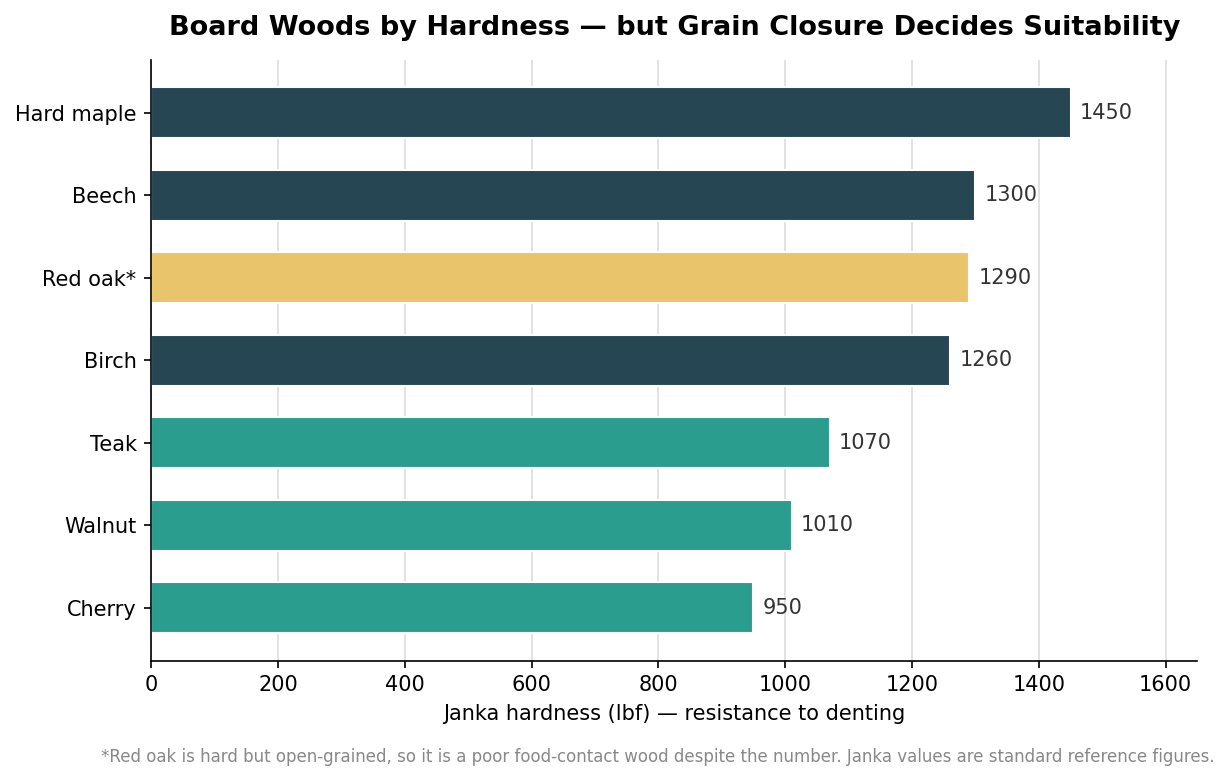
Food safety codes start from a general rule that a food-contact surface must be smooth, free of cracks and chips, nonabsorbent, and easily cleanable. Raw wood seems to fail that test, which is why regulations single it out with a specific carve-out: hard maple, or an equivalent close-grained hardwood, is permitted for cutting boards, butcher blocks, and bakers’ tables. The operative word is close-grained. Tight, small pores give bacteria and moisture nowhere to lodge, which is exactly why maple, beech, birch, cherry, and walnut are the traditional board woods.
Hardness alone does not qualify a wood, and the chart makes the point. Red oak is harder than walnut or cherry, yet its open, porous grain makes it a poor choice for a cutting surface, and it is generally avoided despite the number. Bamboo, often marketed as a board material, is technically a grass rather than a hardwood; it is very hard and can be more abrasive on a knife edge, so treat it as its own category rather than a drop-in for maple.
What NSF and the health inspector actually care about
In a commercial setting the relevant benchmark is the NSF/ANSI sanitation standard for food equipment, and an NSF certification mark is the shorthand that a board meets it. Many plastic and composite boards, including dense polyethylene and paper-composite materials, carry that listing, while comparatively few wooden boards do, and individual health inspectors vary in how they treat wood. That practical gap, more than any outright ban, is why professional kitchens lean on NSF-listed, color-coded plastic for the highest-risk stations even though hard-maple blocks remain permitted for carving and bakery work. For a commercial buyer the sensible split is to use certified color-coded plastic where cross-contamination risk is greatest and reserve wood for the stations where it earns its place. For a home cook or a gift, a well-made hardwood board is entirely appropriate. In every case the local health authority has the final word, so confirm with them before outfitting a regulated kitchen.
Keeping a board on the right side of the rules
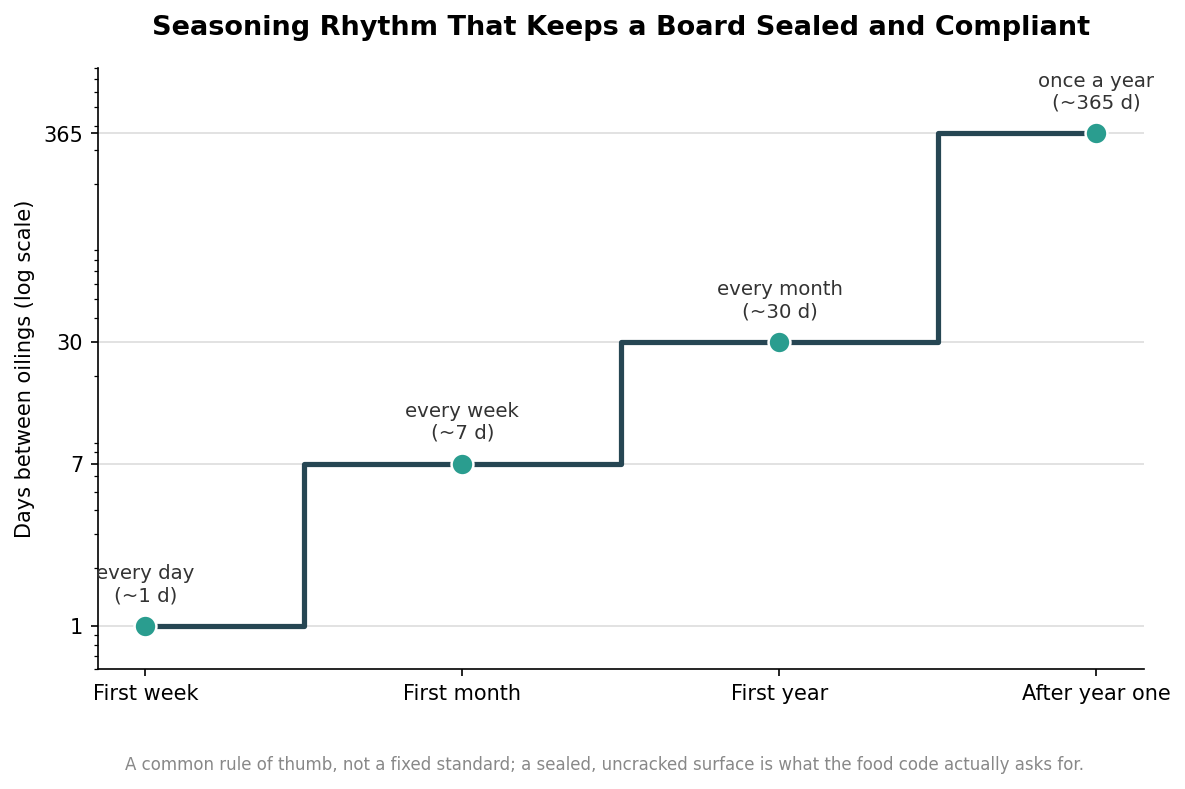
Notice that the code’s language describes a maintained board, not a neglected one: smooth, uncracked, nonabsorbent. A board that has been left to dry out, split, and warp fails all three at once, and no material choice saves it. Sealing is what keeps a wooden surface closed, and the tool is food-grade mineral oil, often with a beeswax topcoat. The classic seasoning rhythm, shown above, is to oil daily for the first week, weekly for the first month, monthly for the first year, and yearly after that. Sand out deep gouges before they become residue traps, and retire any board that cracks through or warps badly. Use only food-safe finishes such as food-grade mineral oil, beeswax, or carnauba, and never a hardware-store drying finish on a surface that food will touch.
Engraving and personalization without compromising safety
For a custom board, engraving is usually the whole point, and it does not make a board unsafe when it is done with a little thought. Laser or CNC engraving removes the sealed surface locally and leaves fine recesses that can hold residue if they sit where the knife lands. The simple rule is to keep deep personalization on the back or around a border rather than in the working center of the board, to re-oil engraved areas so they do not dry and crack, and to accept that a shallow, cleanable branded mark is fine even on a used surface. A board destined purely for display or for serving, rather than chopping, can be engraved anywhere you like. Specify where the artwork goes with the same care you give the wood, and a personalized board stays every bit as food-safe as a plain one.