Once you have settled on construction, the next question for a custom cutting board is which wood to make it from, and it matters more than most buyers expect. Species determines how kind the board is to your knives, how well it resists moisture and bacteria, how cleanly it takes an engraved logo, and how much it costs per unit. Maple, walnut, cherry, beech, teak, acacia, and bamboo all show up in the custom market, and they are not interchangeable. This is a side-by-side look at how they actually compare on the specifications that decide whether a board performs.
Hardness is a balancing act, not a “harder is better” contest
Wood hardness is measured on the Janka scale, and for a cutting board you want a species in a specific middle band rather than the hardest wood you can find. The sweet spot is roughly 900 to 1,500 on the Janka scale. Below that, the board dents and scars quickly and soaks up moisture. Above it, the surface is so hard that it accelerates the dulling of knife edges, which is the opposite of what a good board should do. The chart below plots the common board woods against that ideal band, and the pattern is clear: the species that have earned their reputation as cutting surfaces cluster right inside it.
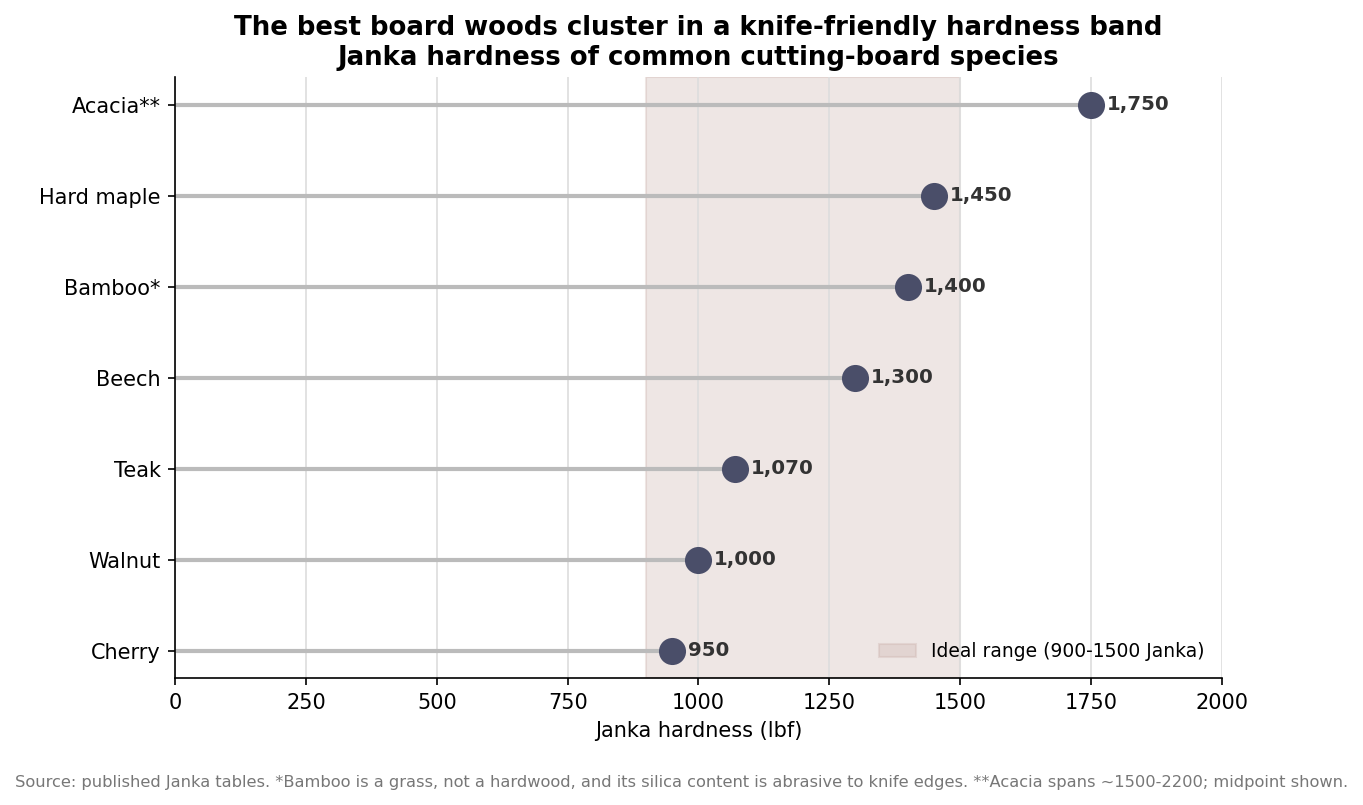
Hard maple sits near the center of that band at about 1,450 Janka, which is a large part of why it has been the default butcher-block wood for generations. Walnut and cherry come in softer, around 1,000 and 950, giving a slightly more forgiving surface that is especially gentle on knives; the trade-off is that they mark a little more easily. Beech at roughly 1,300 is a well-priced middle option common in European boards. Acacia, at a midpoint near 1,750 but ranging as high as 2,200 depending on the exact species, sits above the ideal band, which is worth knowing if edge retention on your knives matters to you.
Grain structure is the real food-safety story
Hardness gets discussed constantly, but grain structure is what actually governs hygiene, and it is the reason a beautiful oak board is a poor choice for a cutting surface. Woods are either closed-grain or open-grain. Closed-grain species have tight pores that give bacteria and moisture far fewer places to lodge, which is exactly what you want on a surface that meets raw food. Maple, walnut, cherry, and beech are all closed-grain, and that is no coincidence with their popularity. Open-grain woods like red oak and ash have visible open pores that can trap liquid and food particles, and they belong in furniture rather than under a knife.
Bamboo deserves a specific note because it is frequently marketed alongside these hardwoods but is not one. Bamboo is a grass, formed into boards by laminating strips with adhesive, and while it is hard and inexpensive, its natural silica content is abrasive and tends to dull knives faster than a true hardwood of similar hardness. It is a reasonable budget and sustainability pick, but it is a genuinely different material, and the harder-on-blades reality is the trade you accept for the lower price.
What each wood does to your unit cost
Species is one of the biggest levers on the price of a custom board, and the spread is wide. For a mid-size custom-engraved board, bamboo anchors the bottom, maple, beech, and acacia occupy an affordable and sensible middle, and the figured, darker woods climb steeply from there.
Walnut and teak sit at the top for different reasons. Walnut is prized for its deep chocolate color and premium feel, and it commands a price to match. Teak carries naturally high oil content that makes it exceptionally water- and warp-resistant, which is why it is a favorite for boards that will see heavy washing, but that same desirability and slower growth keep it expensive. Actual pricing moves substantially with board size, thickness, and how much engraving the design calls for, and bulk orders price below single retail boards; request a free quote for an exact figure.
How well each wood takes your logo
Because these are custom boards, engraving quality is a real specification, not an afterthought, and species affects the result. Lighter, even-toned woods like maple and beech produce a clean, high-contrast laser engrave because the burn darkens visibly against a pale background, which makes them excellent for detailed logos and text. Walnut engraves beautifully in terms of crispness, but because the wood is already dark, the contrast between the engraved mark and the surface is lower, so bold, simple marks read better than fine detail. Cherry lands in between and has the added quirk of darkening naturally over time as it ages, which can subtly change how an engraving reads a year in. For a logo with fine lines or small text, a lighter wood is the safer specification.
Matching the wood to the job
Put the specifications together and the choices sort themselves out. For a durable, knife-friendly, cleanly engraving board at a sensible price, hard maple is the reason it has been the standard for so long and remains the default recommendation. When the board is a premium gift or a showpiece and budget is secondary, walnut delivers the look and feel that justifies the cost. Cherry is the middle-ground choice for a warmer tone that is still gentle on knives, teak is the pick when constant washing and water exposure are the main concern, and bamboo is the honest budget option as long as you accept the faster knife wear. The one consistent rule across all of them is to stay with a closed-grain species in that 900-to-1,500 hardness band, because that is what separates a board that lasts and stays hygienic from one that simply looks the part.