Category: Uncategorized

  • How to Specify a Personalized Cutting Board: Size, Wood, and Engraving

    How to Specify a Personalized Cutting Board: Size, Wood, and Engraving

    Ordering a personalized cutting board is really four decisions stacked on top of each other: how big the board should be, what it is made from, how the design is applied, and how the artwork is prepared. Get those right and the finished board is both usable in a real kitchen and worth keeping. Get them wrong and you end up with a name that is hard to read, a board too small for genuine prep, or a file that has to be redrawn before anyone can cut it. This walkthrough goes decision by decision so you can hand a shop a clear specification the first time.

    Start with size and thickness

    Standard cutting boards fall into four rough size classes. A small board around 8 by 10 inches suits bar work, garnishes, and slicing a single piece of fruit. A medium board near 12 by 18 inches is the everyday workhorse in home kitchens and cafes. A large board around 18 by 24 inches handles high-volume vegetable prep and carving a roast, and an extra-large board near 24 by 36 inches is butcher and dough territory. For a personalized gift board, medium is the safe default: big enough to actually use, small enough to read well standing on a counter. Thickness matters as much as footprint. Roughly 1 to 1.5 inches gives everyday durability and enough mass to keep the board from sliding, while 2 inches or more is reserved for heavy chopping. A thicker board also gives a router more material to bite into if you want a deep, tactile engraving rather than a surface mark. The footprints diverge sharply as you move up the range, so decide by the work the board will do rather than by looks alone.
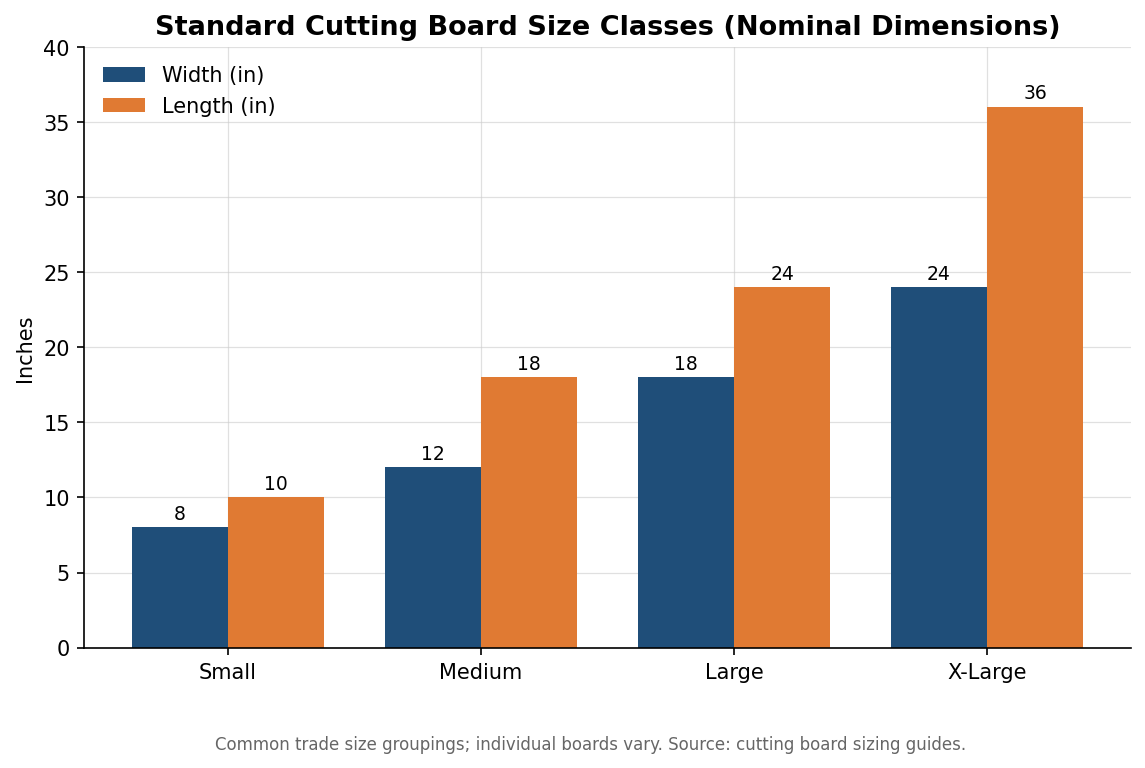
    Grouped bar chart of standard cutting board width and length in inches for small, medium, large, and extra-large sizes
    Standard cutting board size classes, from an 8-by-10 bar board to a 24-by-36 butcher board.

    Pick a wood that shows your design

    Engraving contrast comes down to the wood, not the machine. Light, tight-grained hardwoods carry a burned or carved design most clearly. Maple is the classic choice: pale, smooth, and even-grained, so a logo or name stands out sharply. Cherry starts a warm reddish-brown and darkens with age, which looks rich but softens contrast over time. Walnut is a chocolate brown that reads as premium yet hides lighter engraving; on walnut you generally want a deeper cut so the design registers as texture rather than tone. Bamboo — technically a grass — is dense, sustainable, and engraves cleanly, though its busy surface can compete with very fine detail. Two properties predict how crisp the result will be: lower-resin woods burn lighter and sharper, while high-resin woods char darker, and when the grain figure is too strong it can overshadow fine lines and make text harder to read. Hardness is worth weighing too. A harder surface resists knife scarring and holds a crisp engraved edge, but very hard boards are less forgiving on your knife edges. Avoid softwoods such as fir and larch, whose uneven grain scorches inconsistently, and never engrave treated lumber or formaldehyde-bonded plywood, which can release harmful fumes when cut.
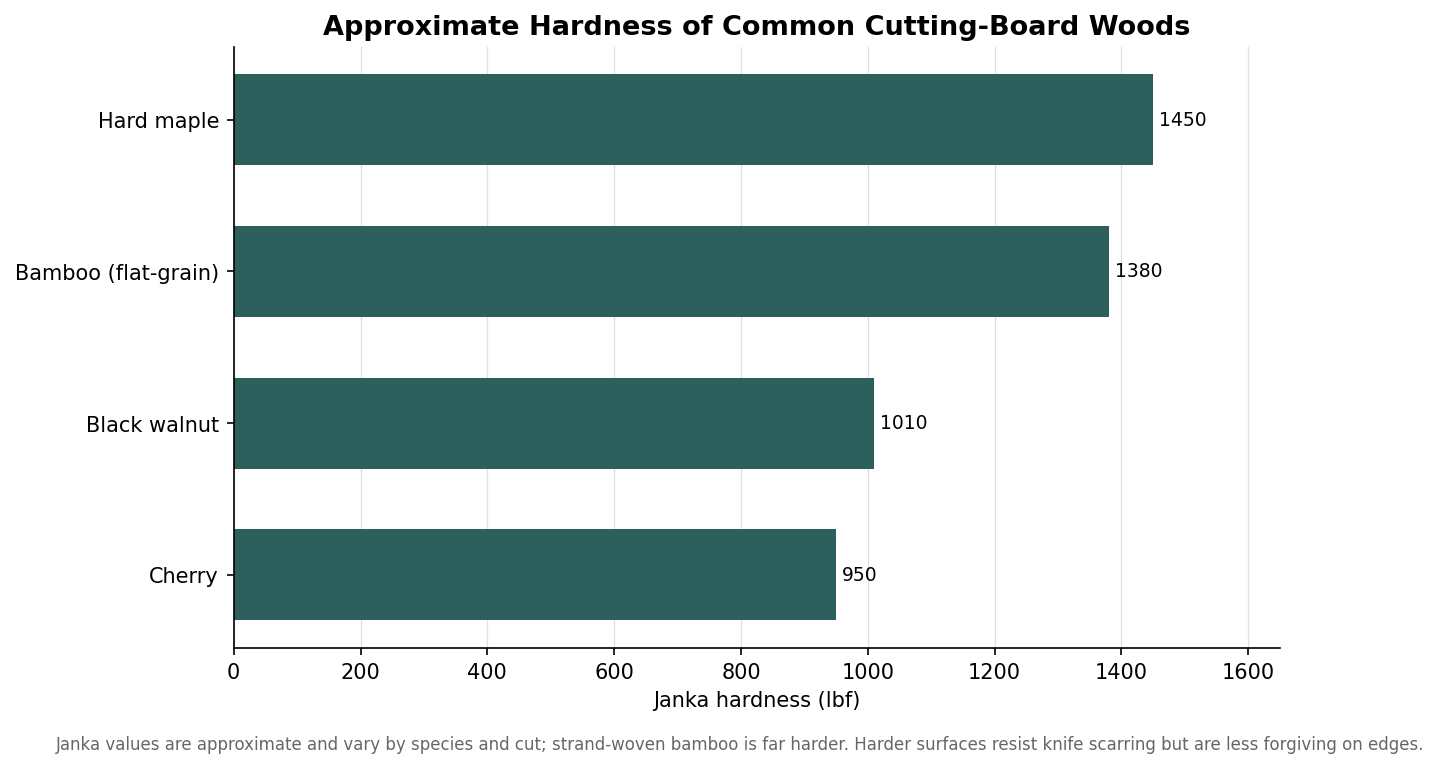
    Horizontal bar chart of approximate Janka hardness in pounds-force for maple, bamboo, walnut, and cherry
    Approximate hardness of common board woods; harder, lighter woods tend to hold a crisper engraving.

    Choose the engraving method

    Two methods dominate. Laser engraving burns the surface with a focused beam and excels at fine detail — small text, photographic shading, intricate logos — with almost no depth. Because a laser mark sits right at the surface, most makers put laser work on the back of a board so daily knife use does not scrape it away. CNC or router engraving cuts a physical V-groove into the wood, producing a deeper, tactile line that survives wear far better but cannot hold the very finest detail a laser can. As a rule of thumb, choose laser for detailed artwork and photographs and a router for bold monograms, names, or a single strong logo you want to feel with a fingertip. Either way, finish the board after engraving with a food-safe mineral oil or a beeswax blend. That step protects both the wood and the design, and it is what keeps an engraved board appropriate for contact with food.

    Prepare artwork that reproduces cleanly

    The single most common cause of a delayed order is artwork that has to be rebuilt. Supply logos and lettering as vector files — AI, EPS, PDF, or SVG — so the edges stay crisp at any size and the shop can scale the design to the board without blurring. Photographs and hand-drawn art should be high-resolution raster files, ideally around 300 dpi at the final engraving size, and it helps to convert them to grayscale so you can preview how the tonal areas will burn. Keep fine text above roughly a quarter inch tall so it survives engraving, and leave a clear margin around the edge rather than running the design to the border. If you are matching a brand, send the exact font and color references even though the engraving itself is monochrome; it helps the shop reproduce the mark faithfully and avoids a second round of proofs.

    Ordering in bulk

    Personalized boards scale well for weddings, real estate closing gifts, and corporate runs, and the unit economics improve quickly with quantity. Customized Cutting Boards starts at just 12 boards, with larger programs running into the hundreds. Per-unit pricing is lowest for small, thin promotional boards at higher volumes and highest for thicker bamboo or handled boards at low quantities; the real figure depends on size, wood, and how much area you engrave, so request a free quote for an exact number. Standard production ships in about 2 weeks after artwork approval; faster turnaround is available with express shipping. Before committing to a full run, ask for a physical or digital proof of the engraving on your chosen wood. Contrast that looks fine on a screen can read very differently burned into walnut versus maple, and one proof board is cheaper than reprinting two hundred.

    A personalized cutting board is a small object with a surprising amount of specification behind it. Decide the size and thickness around how it will actually be used, choose a wood that carries your design, match the engraving method to the artwork, and prepare files that reproduce cleanly. Do that and a single board — or a run of two hundred — comes back looking the way you pictured it.
  • Are Wooden Cutting Boards Food-Safe? What the Science and the Codes Actually Say

    Are Wooden Cutting Boards Food-Safe? What the Science and the Codes Actually Say

    The idea that wood is unsafe for cutting food is one of the most durable myths in the kitchen, and it quietly costs buyers money by steering them away from a board that would have served for decades. The research says something more interesting than the myth, and the health codes are more permissive than most people assume. Here is what is actually established about wood, bacteria, and the rules that govern a commercial prep bench, so you can specify a custom board with confidence instead of hearsay.

    What the research actually found

    The foundational work is Dr. Dean Cliver’s research at the University of California, Davis. When his team applied bacteria to wooden surfaces, the microbes were not recoverable a short time later; they had migrated below the surface, where they died off without multiplying. New plastic could be cleaned effectively, but plastic that had been knife-scarred was very difficult to clean and disinfect by hand, especially once food residue such as chicken fat was in the grooves. A used, heavily cut wooden board behaved almost the same as a new one. Cliver also reported an epidemiological association in which wooden-board users appeared less prone to salmonellosis than plastic-board users, which is worth knowing but is an association rather than proof of cause.

    The mechanism matters more than the headline. Wood wicks moisture, and the bacteria carried with it, down into the fibers where it dries out and dies, while plastic keeps everything on the surface, where a knife-cut groove can shelter it from a quick wipe. That is why the wood-versus-plastic argument has no one-line winner. A board of either material that is cleaned promptly is fine, and a neglected, deeply scarred board of either material is the real hazard. Maintenance, not material, is the variable that actually moves risk.

    Why “close-grained hardwood” is the phrase that matters

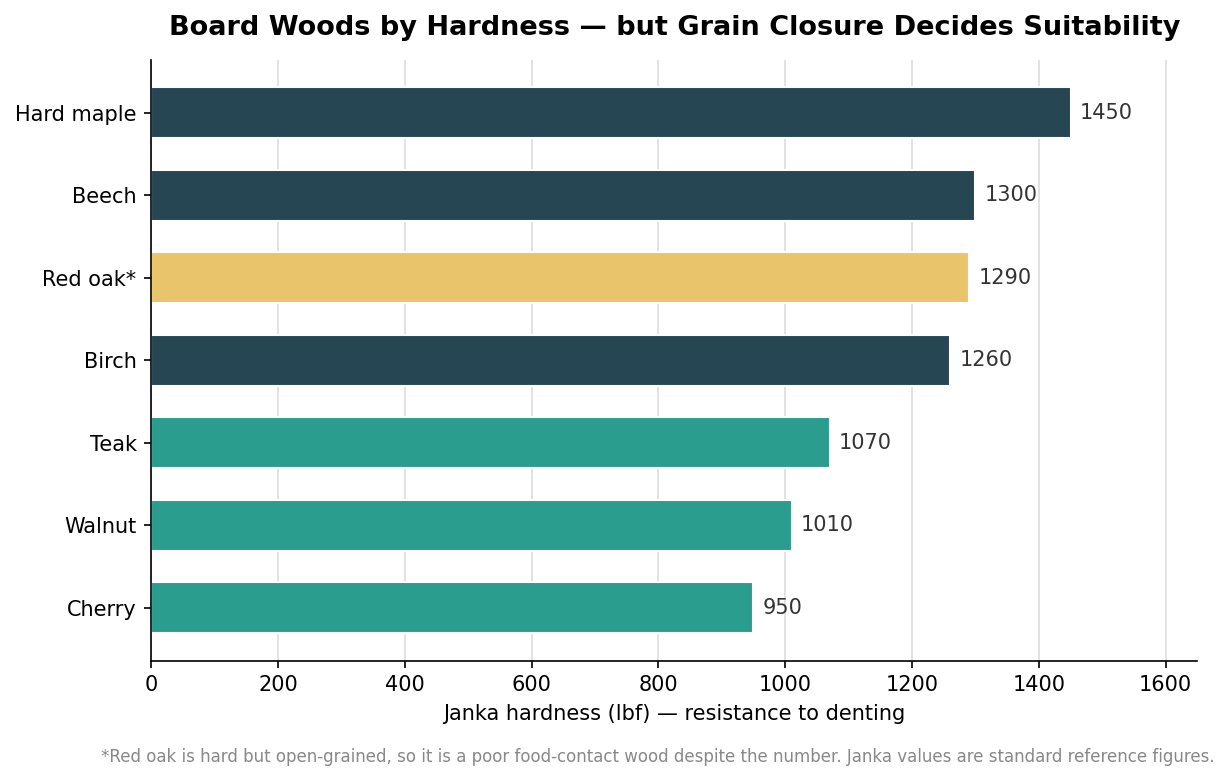
    Horizontal bar chart of Janka hardness for maple, beech, red oak, birch, teak, walnut, and cherry, flagging open-grained red oak
    Hardness varies across board woods, but close grain, not the hardness number, is what makes a wood food-safe.

    Food safety codes start from a general rule that a food-contact surface must be smooth, free of cracks and chips, nonabsorbent, and easily cleanable. Raw wood seems to fail that test, which is why regulations single it out with a specific carve-out: hard maple, or an equivalent close-grained hardwood, is permitted for cutting boards, butcher blocks, and bakers’ tables. The operative word is close-grained. Tight, small pores give bacteria and moisture nowhere to lodge, which is exactly why maple, beech, birch, cherry, and walnut are the traditional board woods.

    Hardness alone does not qualify a wood, and the chart makes the point. Red oak is harder than walnut or cherry, yet its open, porous grain makes it a poor choice for a cutting surface, and it is generally avoided despite the number. Bamboo, often marketed as a board material, is technically a grass rather than a hardwood; it is very hard and can be more abrasive on a knife edge, so treat it as its own category rather than a drop-in for maple.

    What NSF and the health inspector actually care about

    In a commercial setting the relevant benchmark is the NSF/ANSI sanitation standard for food equipment, and an NSF certification mark is the shorthand that a board meets it. Many plastic and composite boards, including dense polyethylene and paper-composite materials, carry that listing, while comparatively few wooden boards do, and individual health inspectors vary in how they treat wood. That practical gap, more than any outright ban, is why professional kitchens lean on NSF-listed, color-coded plastic for the highest-risk stations even though hard-maple blocks remain permitted for carving and bakery work. For a commercial buyer the sensible split is to use certified color-coded plastic where cross-contamination risk is greatest and reserve wood for the stations where it earns its place. For a home cook or a gift, a well-made hardwood board is entirely appropriate. In every case the local health authority has the final word, so confirm with them before outfitting a regulated kitchen.

    Keeping a board on the right side of the rules

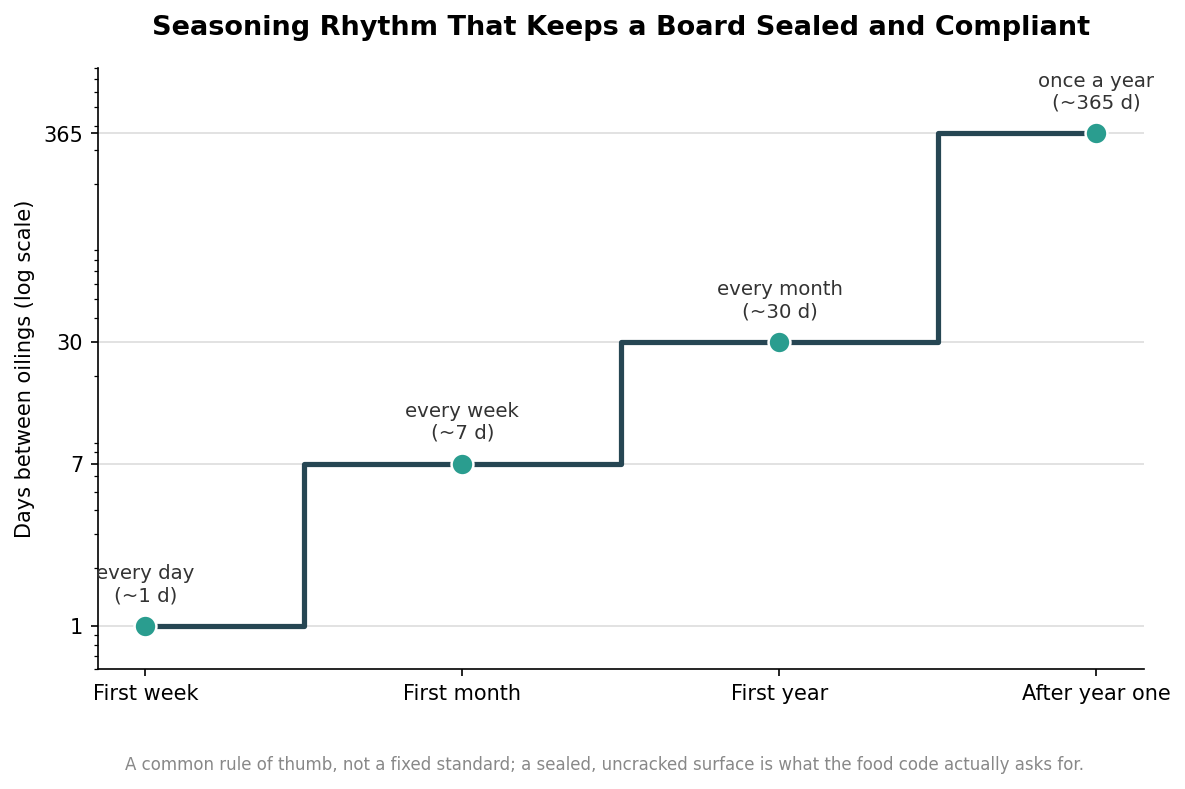
    Step chart on a log scale showing oiling interval increasing from daily to weekly to monthly to yearly over a board's life
    The common seasoning rhythm that keeps a board sealed, and therefore compliant.

    Notice that the code’s language describes a maintained board, not a neglected one: smooth, uncracked, nonabsorbent. A board that has been left to dry out, split, and warp fails all three at once, and no material choice saves it. Sealing is what keeps a wooden surface closed, and the tool is food-grade mineral oil, often with a beeswax topcoat. The classic seasoning rhythm, shown above, is to oil daily for the first week, weekly for the first month, monthly for the first year, and yearly after that. Sand out deep gouges before they become residue traps, and retire any board that cracks through or warps badly. Use only food-safe finishes such as food-grade mineral oil, beeswax, or carnauba, and never a hardware-store drying finish on a surface that food will touch.

    Engraving and personalization without compromising safety

    For a custom board, engraving is usually the whole point, and it does not make a board unsafe when it is done with a little thought. Laser or CNC engraving removes the sealed surface locally and leaves fine recesses that can hold residue if they sit where the knife lands. The simple rule is to keep deep personalization on the back or around a border rather than in the working center of the board, to re-oil engraved areas so they do not dry and crack, and to accept that a shallow, cleanable branded mark is fine even on a used surface. A board destined purely for display or for serving, rather than chopping, can be engraved anywhere you like. Specify where the artwork goes with the same care you give the wood, and a personalized board stays every bit as food-safe as a plain one.

  • Which Wood for a Custom Cutting Board? Maple, Walnut, Cherry and More, Compared

    Which Wood for a Custom Cutting Board? Maple, Walnut, Cherry and More, Compared

    Once you have settled on construction, the next question for a custom cutting board is which wood to make it from, and it matters more than most buyers expect. Species determines how kind the board is to your knives, how well it resists moisture and bacteria, how cleanly it takes an engraved logo, and how much it costs per unit. Maple, walnut, cherry, beech, teak, acacia, and bamboo all show up in the custom market, and they are not interchangeable. This is a side-by-side look at how they actually compare on the specifications that decide whether a board performs.

    Hardness is a balancing act, not a “harder is better” contest

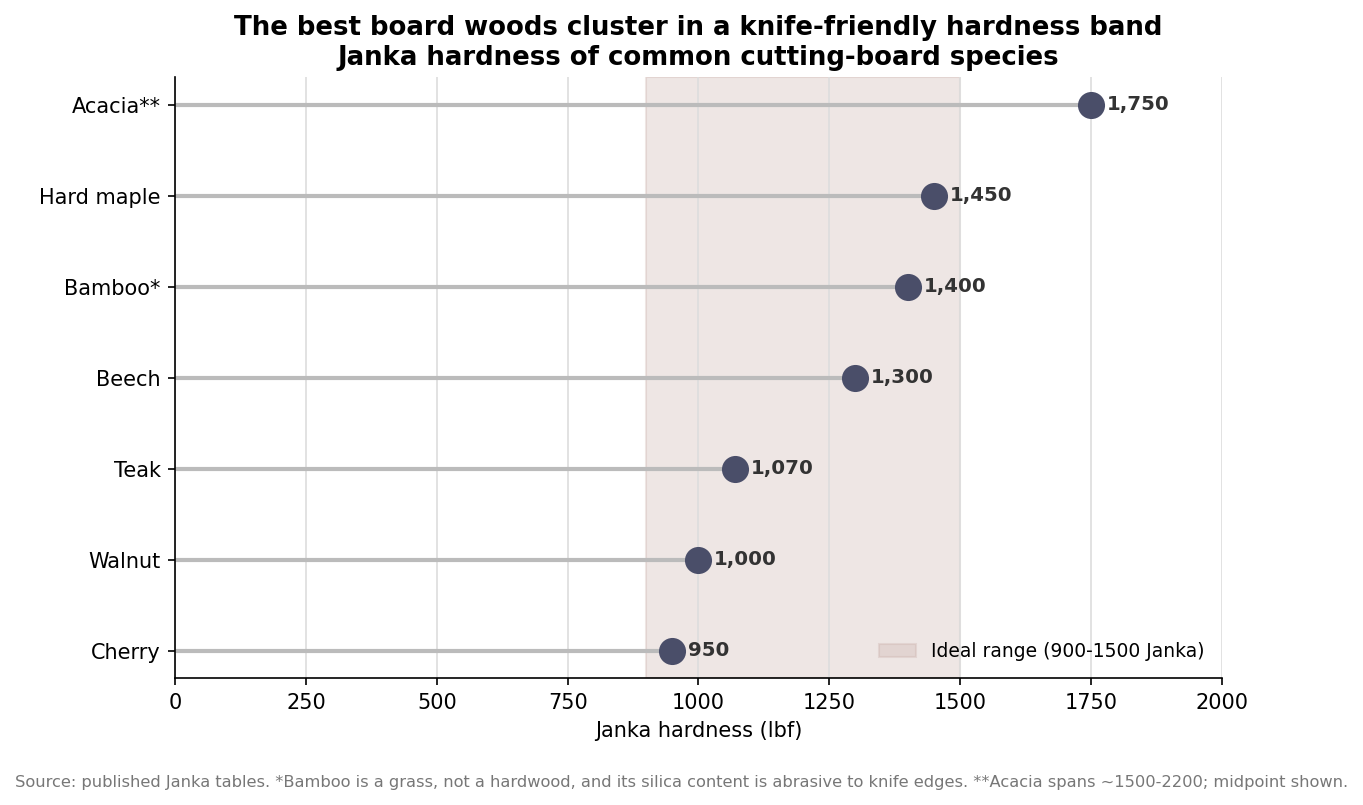
    Wood hardness is measured on the Janka scale, and for a cutting board you want a species in a specific middle band rather than the hardest wood you can find. The sweet spot is roughly 900 to 1,500 on the Janka scale. Below that, the board dents and scars quickly and soaks up moisture. Above it, the surface is so hard that it accelerates the dulling of knife edges, which is the opposite of what a good board should do. The chart below plots the common board woods against that ideal band, and the pattern is clear: the species that have earned their reputation as cutting surfaces cluster right inside it.

    Lollipop chart of Janka hardness for cutting-board woods with the ideal 900-1500 range shaded
    The proven board woods cluster inside the knife-friendly 900-1,500 Janka band.

    Hard maple sits near the center of that band at about 1,450 Janka, which is a large part of why it has been the default butcher-block wood for generations. Walnut and cherry come in softer, around 1,000 and 950, giving a slightly more forgiving surface that is especially gentle on knives; the trade-off is that they mark a little more easily. Beech at roughly 1,300 is a well-priced middle option common in European boards. Acacia, at a midpoint near 1,750 but ranging as high as 2,200 depending on the exact species, sits above the ideal band, which is worth knowing if edge retention on your knives matters to you.

    Grain structure is the real food-safety story

    Hardness gets discussed constantly, but grain structure is what actually governs hygiene, and it is the reason a beautiful oak board is a poor choice for a cutting surface. Woods are either closed-grain or open-grain. Closed-grain species have tight pores that give bacteria and moisture far fewer places to lodge, which is exactly what you want on a surface that meets raw food. Maple, walnut, cherry, and beech are all closed-grain, and that is no coincidence with their popularity. Open-grain woods like red oak and ash have visible open pores that can trap liquid and food particles, and they belong in furniture rather than under a knife.

    Bamboo deserves a specific note because it is frequently marketed alongside these hardwoods but is not one. Bamboo is a grass, formed into boards by laminating strips with adhesive, and while it is hard and inexpensive, its natural silica content is abrasive and tends to dull knives faster than a true hardwood of similar hardness. It is a reasonable budget and sustainability pick, but it is a genuinely different material, and the harder-on-blades reality is the trade you accept for the lower price.

    What each wood does to your unit cost

    Species is one of the biggest levers on the price of a custom board, and the spread is wide. For a mid-size custom-engraved board, bamboo anchors the bottom, maple, beech, and acacia occupy an affordable and sensible middle, and the figured, darker woods climb steeply from there.

    Walnut and teak sit at the top for different reasons. Walnut is prized for its deep chocolate color and premium feel, and it commands a price to match. Teak carries naturally high oil content that makes it exceptionally water- and warp-resistant, which is why it is a favorite for boards that will see heavy washing, but that same desirability and slower growth keep it expensive. Actual pricing moves substantially with board size, thickness, and how much engraving the design calls for, and bulk orders price below single retail boards; request a free quote for an exact figure.

    How well each wood takes your logo

    Because these are custom boards, engraving quality is a real specification, not an afterthought, and species affects the result. Lighter, even-toned woods like maple and beech produce a clean, high-contrast laser engrave because the burn darkens visibly against a pale background, which makes them excellent for detailed logos and text. Walnut engraves beautifully in terms of crispness, but because the wood is already dark, the contrast between the engraved mark and the surface is lower, so bold, simple marks read better than fine detail. Cherry lands in between and has the added quirk of darkening naturally over time as it ages, which can subtly change how an engraving reads a year in. For a logo with fine lines or small text, a lighter wood is the safer specification.

    Matching the wood to the job

    Put the specifications together and the choices sort themselves out. For a durable, knife-friendly, cleanly engraving board at a sensible price, hard maple is the reason it has been the standard for so long and remains the default recommendation. When the board is a premium gift or a showpiece and budget is secondary, walnut delivers the look and feel that justifies the cost. Cherry is the middle-ground choice for a warmer tone that is still gentle on knives, teak is the pick when constant washing and water exposure are the main concern, and bamboo is the honest budget option as long as you accept the faster knife wear. The one consistent rule across all of them is to stay with a closed-grain species in that 900-to-1,500 hardness band, because that is what separates a board that lasts and stays hygienic from one that simply looks the part.

  • End Grain vs Edge Grain vs Plastic: Choosing a Cutting Board Construction

    End Grain vs Edge Grain vs Plastic: Choosing a Cutting Board Construction

    Most cutting board decisions get framed as a wood question, but the choice that actually shapes how a board performs is its construction. Edge grain, end grain, and molded plastic each cut, wear, and age differently, and each suits a different buyer. If you are ordering boards in bulk, personalizing them as gifts, or outfitting a working kitchen, understanding the three constructions will save you from paying for qualities you do not need or skimping on ones you do.

    How the three constructions are built

    Edge grain boards are made by laying long hardwood rails, usually maple, walnut, or cherry, side by side and gluing them together so the long fibers run horizontally across the surface. This is the most common wood board you will see, and it is the more affordable of the two wood constructions because it uses fewer glue joints and less labor. End grain boards flip the geometry: short square blocks of the same hardwoods are stood on end and glued into a checkerboard, so you cut into the tips of the wood fibers rather than across them. That extra cutting, arranging, and gluing is why end grain boards cost more to produce.

    HDPE and other food-grade plastics are molded or cut from solid sheet into a uniform slab with no grain at all. They are the cheapest to produce, the lightest to handle, and the only one of the three that is reliably dishwasher-safe. Each construction answers a different priority, so the honest way to choose is to decide which single property matters most for your use and work backward from there.

    Knife-friendliness and how each surface wears

    End grain boards have a genuine mechanical advantage for knife edges. When a blade meets the standing fibers, it slides between them, the fibers separate, and then they close back up, which keeps the edge sharper for longer and hides cut marks. This self-healing behavior is the main reason serious cooks and knife owners pay the premium. Edge grain boards are still knife-friendly and easy to live with, but they show visible cut lines over time; the upside is that a wood edge grain board can be sanded flat and re-oiled to look new again.

    Plastic behaves differently. It does not dull knives quickly, but it does not heal either. Repeated cutting leaves permanent knife grooves, and once those grooves are deep and numerous they become harder to clean thoroughly and can hold moisture and food residue. The practical answer with plastic is rotation and replacement: run boards until the surface is heavily scored, then retire them, which is manageable precisely because they are inexpensive.

    Wood hardness and why the sweet spot matters

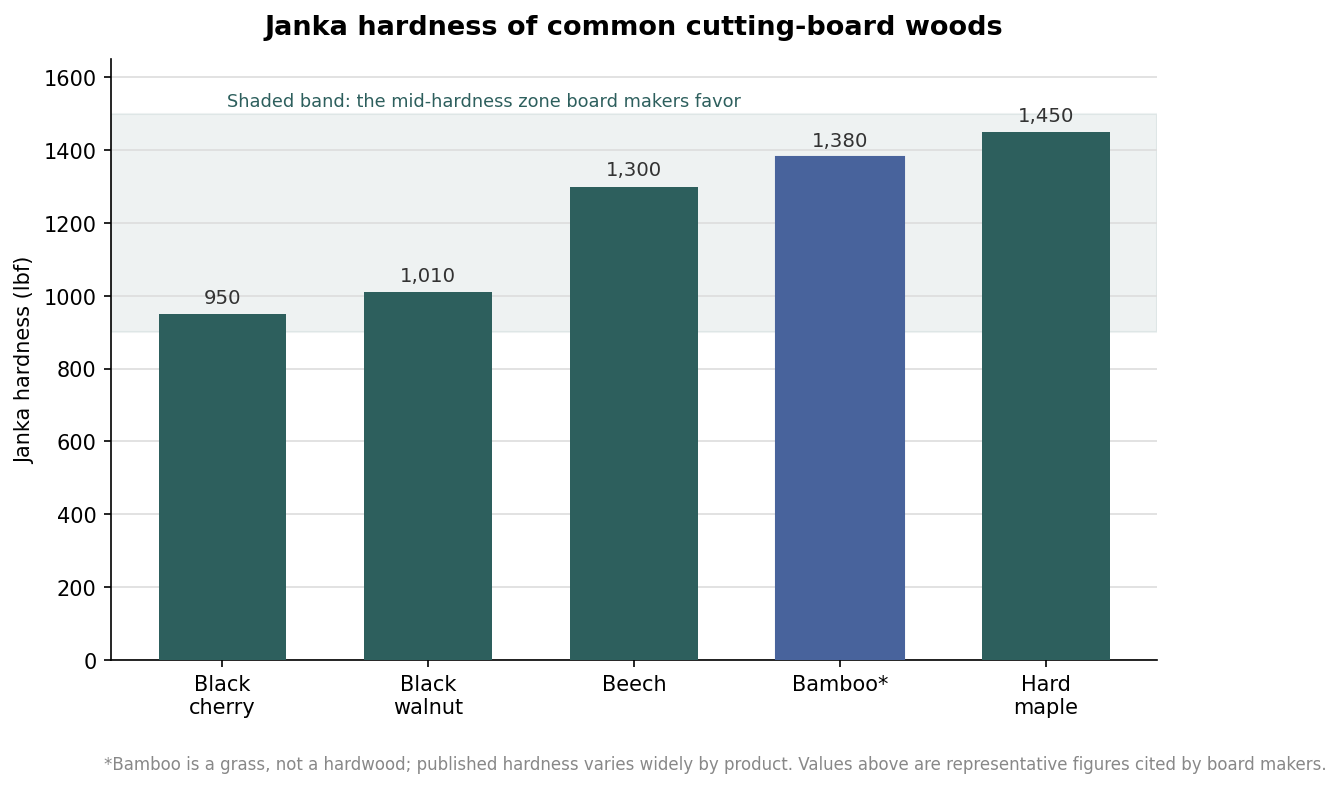
    Among wood boards, the species sets the hardness, and hardness is a balancing act rather than a “harder is better” contest. A board that is too soft scars and gouges easily; a board that is too hard feels punishing under the knife and can accelerate edge dulling. That is why the classic board woods cluster in a middle band of the Janka hardness scale. Black cherry sits around 950 lbf and black walnut around 1,010 lbf, both gentle on edges; beech lands near 1,300 lbf; and hard maple, the workhorse of American cutting boards, comes in at about 1,450 lbf, firm enough to resist scarring while staying kind to blades.

    Bar chart of Janka hardness in pounds-force for cherry, walnut, beech, bamboo, and hard maple cutting-board woods
    Common board woods cluster in a mid-hardness band that resists scarring without punishing knife edges.

    Bamboo often gets marketed as a premium eco option, and representative figures put it near 1,380 lbf, but bamboo is a grass rather than a hardwood, its published hardness varies widely by product, and the adhesives and fibrous structure make it noticeably tougher on knife edges than maple or walnut. If edge retention is a priority, treat bamboo with more skepticism than its marketing suggests. Exotic woods like teak are sometimes cited at much higher hardness numbers, but those figures are inconsistent across sources and species, so verify the specific product rather than trusting a single quoted value.

    Thickness, weight, and upkeep

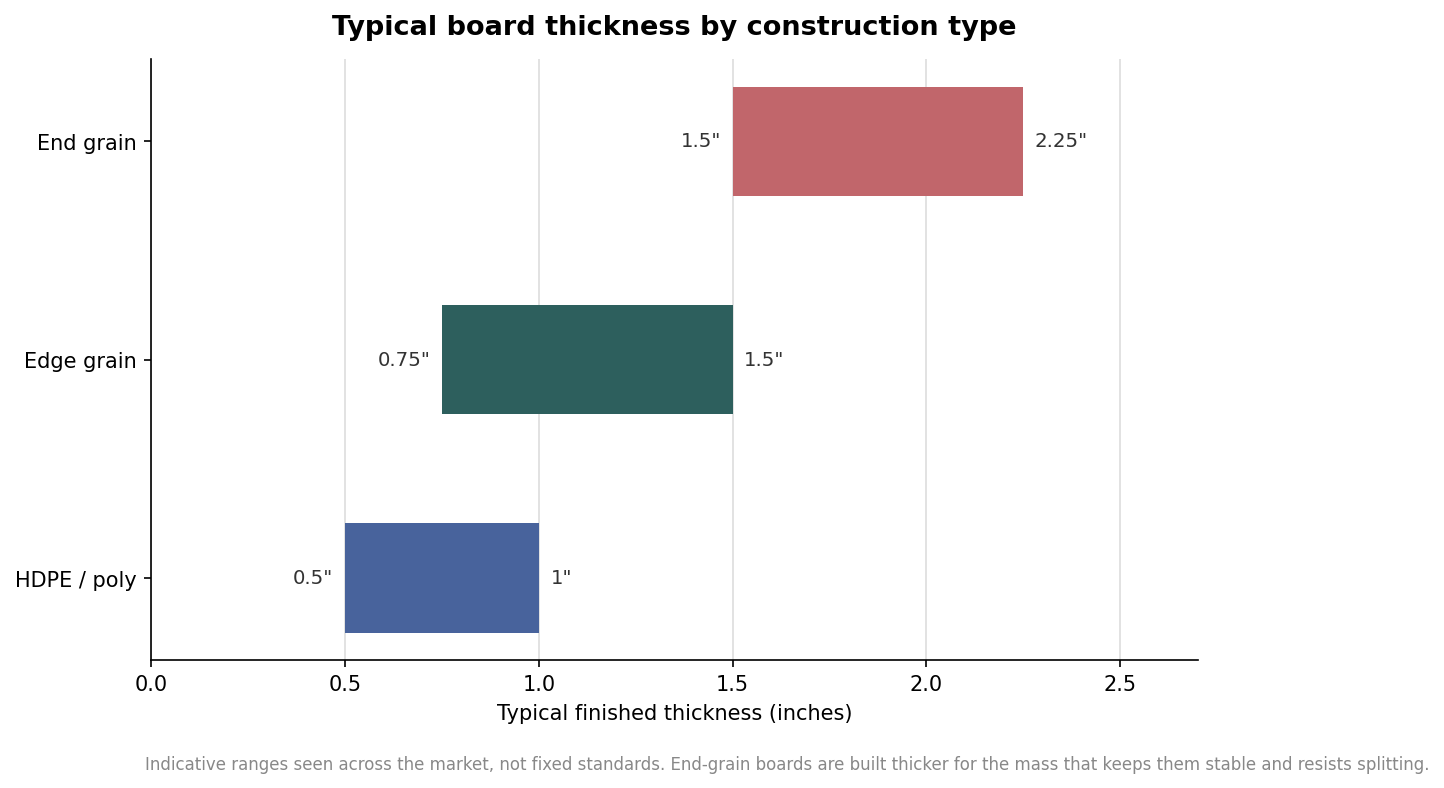
    Construction also drives how thick and heavy a board needs to be. End grain boards are built thick, commonly in the range of one and a half to over two inches, because that mass keeps the checkerboard stable and resists the splitting that end-grain construction is prone to if it dries unevenly. Edge grain boards are typically three-quarters of an inch to about an inch and a half, and plastic boards are often around half an inch to an inch. Those are indicative market ranges rather than fixed standards, but the pattern holds: the more premium the wood construction, the more board you are lifting, storing, and washing by hand.

    Horizontal range chart of typical finished thickness for HDPE plastic, edge grain, and end grain cutting boards
    End-grain boards are built thickest for the mass that keeps them stable; plastic boards are the thinnest and lightest.

    Upkeep tracks the same lines. Both wood constructions need regular food-safe mineral oil and occasional board cream to stay sealed, and end grain generally drinks up more oil because of all the exposed fiber ends. Neither wood board should go in a dishwasher or soak in water. Plastic asks for almost nothing beyond hot soapy water or a dishwasher cycle, which is exactly why it dominates in high-volume settings where boards are washed constantly and cross-contamination rules require frequent sanitizing.

    Matching the construction to the buyer

    For a personalized gift or a centerpiece board that will be shown as much as used, end grain is the natural pick: it looks the most impressive, protects good knives, and carries engraving beautifully on its dense end surface. For everyday home cooking or a bulk order where value and easy refinishing matter, edge grain hardwood is the sensible middle, delivering most of the warmth and knife comfort of wood at a lower cost and weight. For commercial kitchens, food trucks, and any setting governed by sanitation protocols, plastic earns its place through low cost, light weight, dishwasher tolerance, and the ability to run a separate color-coded board for each food group.

    There is no single best construction, only the one that fits how the board will be used and how much handling and upkeep the owner will realistically give it. Decide whether knife protection, refinishing, or effortless sanitizing is the property you are unwilling to compromise on, and the right construction usually chooses itself.

  • The Complete Buyer’s Guide to Custom Cutting Boards

    If you’re shopping for custom cutting boards for the first time, the price range online can feel random — a budget price on one site, a premium one on another, for what looks like the same board. It isn’t random. Material, board construction, and engraving method each move the price independently, and vendors bury the numbers that actually matter (minimum order quantity, turnaround time) in FAQ pages you have to dig for. This guide pulls those factors together so you know what a reasonable quote looks like before you request one.

    Whether you’re ordering a single personalized wedding gift or outfitting a corporate gift program with fifty branded boards, the same three variables drive your quote: wood species, board construction (edge grain vs. end grain), and how the design gets applied. We’ll walk through each with current pricing.

    What custom cutting boards actually cost, by material

    Price is driven first by wood species, not by the engraving. Bamboo is a grass, not a hardwood, and it grows fast, which keeps raw material costs down — personalized bamboo cutting boards are the most economical option, with size and design complexity setting the final price. Solid hardwoods cost more to source and mill. Personalized maple boards, one of the most popular choices for engraving because of its light, tight grain, typically sit in the mid-range for a standard single-board gift. Walnut, prized for its dark color and dramatic contrast against laser engraving, spans a wider range, from modest for a small board to premium for a large, thick one.

    Construction matters as much as species. An edge-grain board — strips of wood glued face-to-face — is the standard for personalized gifts and commonly sits at the premium end for a quality hardwood piece. End-grain construction, where the wood is oriented so the end fibers face up (better for knife self-healing, harder to make), is a different tier entirely; end-grain butcher-block-style boards are the most expensive construction. If a quote for a custom cutting board seems unusually cheap for hardwood, ask whether it’s edge grain or a thin veneer over a cheaper substrate — that’s usually where the savings come from.

    Bamboo is the budget entry point; end-grain hardwood construction is the premium tier.
    Material / Construction Relative Price Tier
    Bamboo (personalized, standard size) Entry level
    Maple (personalized, edge grain) Mid-range
    Walnut (edge grain, varies by size) Mid-range to premium, by size
    Hardwood edge-grain (maple/cherry/walnut, larger) Premium
    End-grain butcher block Top tier
    Bamboo is the budget entry point; end-grain hardwood construction is the premium tier.Source: CuttingBoard.com blog, "Why Acacia is Becoming a Popular Wood for Cutting Boards," and current retail listings, accessed August 2026

    Minimum order quantities: what vendors really require

    Customized Cutting Boards starts at just 12 boards, which covers a wedding party, a real estate closing gift list, or a first corporate program. Mixed hardwood and bamboo boards in one order count toward the same minimum.

    Pricing is tiered, with cost per board dropping in steps as quantity increases rather than requiring one large jump to wholesale volume.

    Ordering a small run of boards

    If you need a small run of personalized boards — a bridal party, a small office gift run — the 12-board minimum covers it. Per-board pricing is higher at the low end of the range and steps down as quantity grows, so it’s worth asking for a quote at your exact quantity.

    Lead times: how fast you can actually get a custom cutting board

    With Customized Cutting Boards, standard production ships in about 2 weeks after artwork approval; faster turnaround is available with express shipping.

    Shipping transit time is extra, and engraving shops get backed up in the six weeks before Christmas and around wedding season (May through October), so if you’re ordering a custom cutting board as a gift for a specific date, allow about 2 weeks for production plus shipping time, and order earlier if your date is fixed.

    Choosing wood species for engraving contrast and durability

    Not every wood engraves the same way, and that should factor into your material choice as much as price does. Maple’s pale, tight grain gives laser engraving crisp, high-contrast lines, which is why it’s the default choice for text-heavy designs like recipes, family names, or wedding dates. Walnut’s dark natural tone means the engraving itself shows up lighter than the surrounding wood — good for bold logos and monograms, less ideal for fine detail, which can get lost against the darker background. Cherry sits between the two, with a warm mid-tone that darkens further with age and UV exposure over the years.

    Bamboo is technically a grass, and it’s harder and more moisture-resistant than most hardwoods, which is part of why it’s become the default for high-volume corporate and promotional orders — it holds up to dishwasher-adjacent kitchen use better than softer woods and costs less to source at scale. The tradeoff is a more uniform, less characterful grain pattern than a walnut or cherry board, and engraved lines on bamboo can show slightly more fuzzing at the edges than on tight-grained maple.

    Bulk and corporate custom cutting board orders

    Corporate and promotional orders follow a different cost curve than personal gifts. Business-logo programs are quoted per job, so if you’re budgeting a client-gift or employee-recognition run, request a free quote from Customized Cutting Boards with your logo and quantity before you set a number. As with most bulk manufacturing, per-unit cost drops as order size increases, and bamboo is disproportionately common in these programs specifically because it keeps the per-unit cost low enough to make three-figure order quantities affordable.

    When requesting a bulk quote, get the vendor to break out three numbers separately: cost per board at your target quantity, setup or die/template fee (many engravers charge this once per unique design, not per board), and shipping. A quote that only states a per-board number without disclosing a setup fee can end up 15-20% higher than expected once that fee gets added at checkout.

    Frequently asked questions

    How much does a custom cutting board typically cost?

    For a single personalized board, bamboo is the most economical, maple sits in the mid-range, and walnut costs more as size increases, with larger or end-grain hardwood boards at the top of the range. Price is set by wood species, size, construction and engraving, and corporate logo orders get lower per-unit pricing as quantity rises. For an exact price, request a free quote with your logo and quantity.

    Is there a minimum order quantity for custom cutting boards?

    Yes — Customized Cutting Boards starts at just 12 boards, with bulk pricing tiers as quantities grow.

    How long does it take to get a custom cutting board made?

    Standard production ships in about 2 weeks after artwork approval; faster turnaround is available with express shipping. Allow extra shipping time during the holiday season and peak wedding months (May–October).

    What's the best wood for engraved text or a logo?

    Maple gives the highest contrast for fine text because of its pale, tight grain. Walnut works well for bold logos and monograms but can lose fine detail. Bamboo is durable and budget-friendly for bulk orders, though its grain shows engraving with slightly less crispness than maple.

    What's the difference between edge-grain and end-grain cutting boards?

    Edge-grain boards are made from strips of wood glued face-to-face and are the standard, more affordable construction for personalized gifts. End-grain boards orient the wood fibers vertically, which is gentler on knife edges and self-heals better, but is more labor-intensive to build — these sit at the top of the price range.

    Do bulk corporate cutting board orders have a separate setup fee?

    Often, yes. Many vendors charge a one-time setup or template fee per unique design in addition to the per-board price. Ask for this to be broken out separately in your quote so you can compare vendors accurately.

    The bottom line

    The spread in custom cutting board pricing isn’t a sign that some vendors are ripping you off and others aren’t — it reflects real differences in material and construction. A basic bamboo board and an end-grain walnut board are legitimately different products, not the same thing marked up. Match the material to the occasion: bamboo for budget-conscious bulk gifting, maple for crisp personalized text, walnut or cherry for a board meant to be a centerpiece gift. Whatever you choose, get the lead time and any setup fees in writing before you order, especially if you’re working against a wedding date or a holiday deadline.

  • Color-Coded Boards: Getting a Commercial Prep Bench Right

    Color coding exists because a new starter under pressure will not read a label. Handing them a red board for raw meat removes the decision entirely, and that is the whole mechanism.

    The standard convention

    Red for raw meat, blue for raw fish, yellow for raw poultry, green for produce, brown for cooked meat and white for dairy and bakery. Conventions vary slightly by region and by operator.

    Pick one, print it on a wall chart, and print the category on the board itself. A board that says RAW MEAT on it is followed far more reliably than a red board that a new starter has to map from memory.

    Wood has no place in raw prep

    Porous surfaces cannot be reliably sanitized after raw protein. That is the entire reason commercial kitchens use polyethylene, and it is not a matter of preference.

    Keep hardwood for bread, produce, cheese and presentation. Use NSF-certified HDPE for everything raw, and be able to say so if asked.

    Thickness and replacement, not repair

    HDPE is a consumable. When scoring is deep enough that it cannot be cleaned to the bottom of the grooves, the board is finished, and no amount of scrubbing changes that.

    Half-inch boards are fine for light work; three-quarter inch lasts longer under heavy chopping and can be resurfaced once. Budget replacement sets annually rather than nursing scored boards through an inspection.

    Fit the bench, not the catalog

    Stock board sizes rarely match a specific prep bench or a drop-in well, and an overhanging board slides. Cut to size costs very little and it is the difference between a system used as designed and boards stacked in a corner.

    Non-slip feet or a damp cloth underneath — but feet mean the board only works one way up, which halves its life. For most kitchens, no feet and a cloth is the better answer.

    Mark them for accountability

    Laser marking the site number, station or kitchen name onto each board stops sets migrating between rooms, which is the quiet way color-coding systems decay in multi-site operations.

    It costs almost nothing at order time and cannot be done afterwards.

    What to send us

    Your bench dimensions, the color convention you use, the category wording you want printed, and any site or station numbering. We will quote matched sets cut to size with everything marked.

  • How to Keep a Wooden Board Out of the Bin

    Almost every wooden board that fails does so for one of two reasons, and both are preventable with information the recipient never received.

    Reason one: it went in the dishwasher

    A dishwasher combines prolonged soaking with high heat, which swells the wood and then dries it fast and unevenly. That differential is what splits a board along a glue line or across the grain.

    Hand wash, both sides, and stand the board on edge to dry rather than leaving it flat on a counter where one face dries and the other does not.

    Reason two: it was never oiled

    Wood loses moisture continuously in a heated home. Food-safe mineral oil replaces it and keeps the board dimensionally stable; a board that is never oiled will eventually cup, then crack.

    Monthly for the first year, then whenever the surface looks dry and pale. It takes two minutes and it is the single highest-value thing an owner can do.

    Which oil, and which to avoid

    Food-grade mineral oil, or a mineral oil and beeswax board cream. Both are inert and will not go rancid.

    Avoid cooking oils — olive, vegetable, sunflower. They are organic and they oxidize, which is to say they go rancid inside the wood and the board starts to smell. This is the most common well-intentioned mistake.

    Cleaning without soaking

    Hot water, mild soap, a cloth or brush, and dry immediately. Never leave a board sitting in a sink.

    For odors and light staining, coarse salt with half a lemon scrubbed over the surface works genuinely well and costs nothing. For sanitizing after raw work on a wooden board — use a poly board instead.

    Bringing a tired board back

    Sand lightly with 220 grit along the grain, wipe clean, then oil generously and let it soak overnight. Most boards written off as ruined come back completely.

    Engraving survives light sanding because it is burned some depth into the wood, which is one more argument against surface printing.

    What to put on the care card

    Four lines: hand wash and dry immediately, never dishwasher, oil monthly with food-grade mineral oil, stand on edge to dry. That is the whole thing.

    We print and include one with every board as standard, because the alternative is a customer blaming your brand for a crack that a sentence would have prevented.